


Questions about Schumer’s future grow as Democratic candidates call for change
Questions about Schumer’s future grow as Democratic candidates call for change

Alexander Bolton Mon, August 17, 2026 at 11:45 AM UTC
29
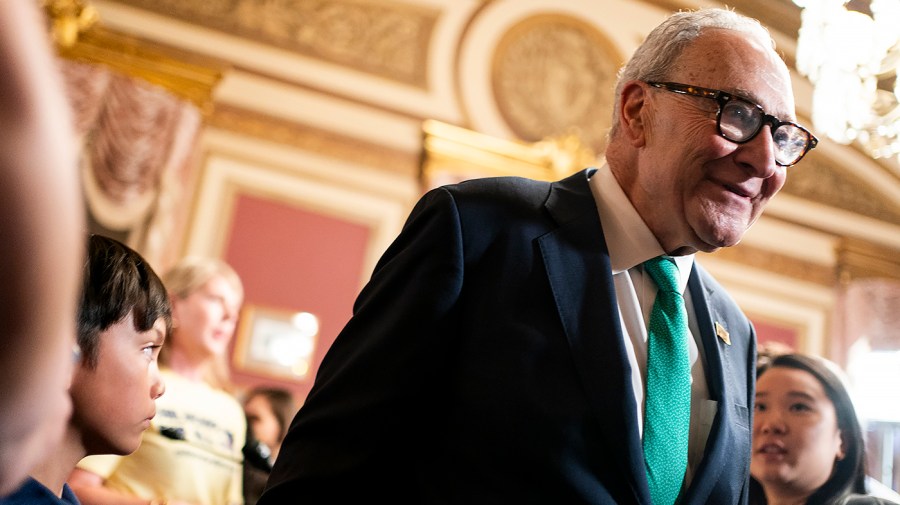
Questions are growing about Sen. Chuck Schumer’s (D-N.Y.) future as an increasing number of Democratic candidates say they will not support his bid for another term as Senate Democratic leader.
Progressive critics of the Democratic establishment are calling for a leadership shake-up in Washington as their candidates win Senate Democratic primaries in Illinois, Maine, Michigan and Minnesota.
These candidates have the backing of progressive Democratic senators in Schumer’s caucus. They say the party has become too aligned with corporate interests and is not fighting hard enough to increase taxes on the wealthy and expand the social safety net.
Progressive candidates Abdul El-Sayed in Michigan, Peggy Flanagan in Minnesota and Troy Jackson in Maine, who are all running as Democratic Senate nominees, say they will not vote for Schumer as leader.
Illinois Lt. Gov. Juliana Stratton, who won the Democratic primary to succeed retiring Democratic Whip Dick Durbin (D-Ill.), said in March she won’t vote for Schumer to serve another term because “voters all across the state of Illinois” are “fed up with what’s happening in Washington.”
Even so, Senate Democratic insiders say Schumer, who is 75, is likely to remain as Democratic leader. Schumer is hailed by these voices as a tireless worker and prodigious fundraiser for his party and colleagues.
Schumer’s allies note that he scored impressive recruiting wins in North Carolina, Ohio, Iowa and Alaska. Schumer played a key role in convincing candidates such as former North Carolina Gov. Roy Cooper (D), former three-term Ohio Sen. Sherrod Brown (D), Iowa state Rep. Josh Turek (D) and former Alaska Rep. Mary Peltola (D) to run for the Senate.
A Democratic senator who requested anonymity to talk about Schumer’s future said there doesn’t appear to be a challenger in the caucus gearing up, though the lawmaker warned that could change if Senate Democrats underperform in the November elections.
The lawmaker argued that the victories of progressives in Senate primaries shows that voters are hungry for political leaders who will take on entrenched corporate interests.
“It sends a really powerful message that Americans are increasingly fed up with oligarchs, dark money, corporations having all the power and folks who are campaigning saying they will take on the establishment have enormous appeal,” the senator said. “Any party that doesn’t listen to that, on both sides of the aisle, is probably screwing up.”
“There’s a sense from a lot of people, probably on both sides of the aisle, that the folks here [in the Senate] in the end do work for the powerful,” the senator said, noting that special interest groups spent $60 million to defeat El-Sayed in his race against Rep. Haley Stevens (D-Mich.).
“People realize they can take on these powerful issues and make it an issue that they’re spending these vast sums,” the senator said.
One of Schumer’s strongest attributes as a leader has been his ability to raise huge sums of money for candidates and the party, but now his connections to deep pockets could become a target for progressive critics to use against him.
The senator said Schumer’s future would depend heavily on how progressive critics such as El-Sayed fare in the general election and whether Democrats pick up a good number of seats when they have the political wind at their backs because of President Trump’s low approval numbers.
A strategist allied with Schumer and other Democratic leaders, however, pushed back on the narrative that the progressive left is gaining more influence and will push the party further to the left.
“Clearly Abdul is very talented, and we’ll see where all this ends,” said the strategist, who cautioned that progressives need to show they can win outside of heavily Democratic blue states. Democratic socialist candidate Francesca Hong notably lost in a Wisconsin Democratic primary for governor last week.
“Is the party really moving left? Is it really? That’s the mainstream [media] narrative, but is it?” the strategist said. “Does the data really yield that we are really moving left, that that is the majority of the party?”
Senate insiders see Sen. Brian Schatz (D-Hawaii), who has locked up the votes to become Senate Democratic whip, as a candidate to succeed Schumer one day. Whip is the No. 2 position in leadership.
But there’s growing buzz around Sen. Catherine Cortez Masto (Nev.), a more centrist Democrat, who has a talented staff working for her and an impressive fundraising network to draw on if she ever ascends to the top spot.
Democratic strategists are split on how much opposition Schumer faces within his own party.
Steve Jarding, a Democratic strategist and former senior aide to the Democratic Senatorial Campaign Committee, said Schumer’s future in leadership depends on picking up a good number of Senate seats this fall.
“It’s still a numbers game at the end of the day. And if the Democrats don’t do well, and it’s at least 50-50 [in the Senate next year] I just think in this cycle with all the energy — if we take the House and we fall short in the Senate — somebody is going to have to pay a price and obviously the most likely person is Chuck Schumer,” he said.
Jarding said Schumer has become “the status quo, establishment” leader.
Advertisement
“I think that train has left the station a long time ago. It’s not where the American public is,” he said. “Democrats have 41 percent approval and Republicans [have] 39” percent approval.
“If the Democrats take back the Senate, at least he’s got a case to say, ‘I was the leader when we took back the Senate,’” he added.
Jarding warned that if Senate Democratic candidates perform worse than expected in November, Schumer could face trouble.
But Jim Kessler, a former Schumer aide, said Schumer’s job is safe and that the Democrats who say they won’t support him serving another term as leader are a small fraction of the caucus.
“If Democrats can take the Senate, Chuck Schumer is the leader. Period, the end,” he said. “Even though there are going to be some new members, part of their primary campaign was running against Schumer as leader, that was a tiny part of the caucus.
“Leaders don’t get replaced because they won,” he said. “If Democrats are going to retake the Senate, it means the folks Schumer … nurtured to get into the race won.”
Kessler, the executive vice president for policy at Third Way, a centrist Democratic think tank, pointed out that Schumer just needs to win a majority of his own caucus — unlike someone running for Speaker in the House, who needs a majority of the entire chamber in a floor vote.
Sen. Chris Van Hollen (Md.) is another rising Senate Democratic star in the mix of names being discussed to someday become Senate Democratic leader.
Van Hollen is naturally allied with Senate progressives who want the next Democratic leader to push a more ambitious agenda and do more to take on corporate and special interests.
Van Hollen in an interview with CNN last month declined to say whether he would support Schumer remaining as Democratic leader beyond 2026, saying he is “focused on the 2026 elections.”
“Van Hollen is interested, and the progressives like him more,” said a source familiar with jockeying among Democratic senators for possible future leadership bids.
Sen. Elissa Slotkin (D-Mich.) in June called for “new leadership” within the Democratic Party, arguing that the party hasn’t fully recovered from its 2024 elections losses.
“Every day there’s a debate within the party about the path forward,” she told SiriusXM’s “Straight Shooter” podcast with Stephen A. Smith.
Sens. Bernie Sanders (I-Vt.) and Elizabeth Warren (D-Mass.), who want the Democratic Party to adopt a bolder agenda and challenge corporate interests more aggressively, have flexed their muscle by endorsing winning progressive candidates in competitive primaries.
They won’t yet talk about what big progressive wins should mean for the future of the Senate Democratic leadership — or Schumer’s future — but they are preparing to claim a mandate if the election goes as they hope.
Sanders hailed El-Sayed’s victory in the Michigan Senate Democratic primary as a watershed moment, calling it “the biggest upset” in his life. He said El-Sayed had to “take on the Michigan Democratic establishment, the national Democratic establishment” and $60 million in super PAC spending deployed against him.
But Sanders declined to talk about El-Sayed’s desire to replace Schumer with Van Hollen.
“That’s not, I think, the major issue of today,” he said.
Warren says she’s focused on the November election, not a future battle over the Senate Democratic leadership.
“My goal is to get people who will fight for America’s working families here in the Senate and every vote counts,” she said, declining to discuss her own leadership ambitions within the caucus. “I want to do everything I can to help working families. We need a Democratic Party that’s willing to do that.”
Warren, who is 77, is not viewed as a likely leadership candidate, but she will wield more influence in the conference if El-Sayed and other progressives, such as Jackson in Maine and Flanagan in Minnesota, win on Nov. 3.
This story was at 7:45 a.m.
Copyright 2026 Nexstar Media, Inc. All rights reserved. This material may not be published, broadcast, rewritten, or redistributed.
For the latest news, weather, sports, and streaming video, head to The Hill.
Source: “AOL Breaking”
